Situation:
An online retailer faced frequent inventory shortages and inefficiencies due to unpredictable demand. With over 1 million daily sales records across 5 years, the challenge was to build a forecasting system that could anticipate order quantities for hundreds of products, balance stock availability, and reduce costs.
Task:
Our objective was to design and compare multiple time-series forecasting models to predict 12-month future demand for each product. The system needed to capture both trend and seasonality, handle missing data, and minimize prediction error across 300+ product categories.
Action:
- Data Preparation:
- Cleaned raw dataset, performed integrity checks, and handled missing values with linear interpolation.
- Created features (e.g., ActualPrice = ProductPrice – Discounts), aggregated monthly data, and identified discontinued products.
- Modeling:
- Implemented ARIMA, SARIMA, SARIMAX for statistical forecasting.
- Applied Double & Triple Exponential Smoothing (DES, TES) to capture trend and seasonality.
- Trained an LSTM deep learning model for sequence-based forecasting.
- Evaluated models using MAE, MAPE, and Percentage Error on 341 products.
- Analysis:
- Used ACF/PACF plots to identify lag dependencies.
- Decomposed time-series into trend, seasonality, and residuals for pattern discovery.
- Compared model performance across seasonal vs. non-seasonal products.
Result:
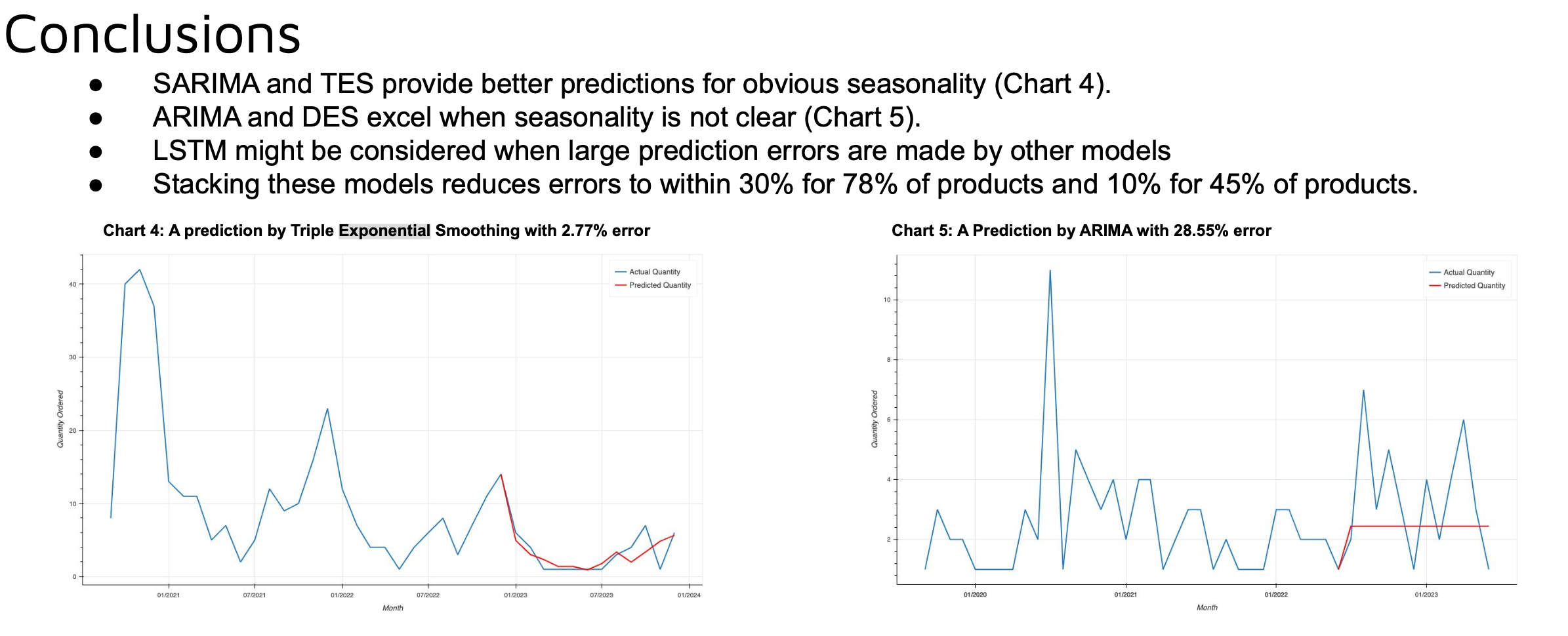
- Achieved <30% error for 78% of products and <10% error for 45% of products by stacking models.
- SARIMA and TES performed best for products with strong seasonal patterns, while ARIMA and DES excelled on non-seasonal items.
- LSTM showed potential on complex cases but required more training data.
- Provided actionable forecasts that helped retailers minimize shortages, improve stock planning, and enhance customer satisfaction.
Download and view the poster below:
 Shubham Mishra