Situation:
Chicago faces one of the most complex crime landscapes in the U.S., with millions of recorded incidents over two decades. Law enforcement and policy makers often lack clear, data-driven insights into crime patterns, hotspots, and temporal trends, making effective prevention and resource allocation challengingChicago Crime ReportAnalysis on Chicago Crimes.
Task:
Our objective was to analyze a massive dataset (~8 million crime records, 36 crime types, spanning 2001–2024) to uncover hidden patterns, identify crime hotspots, and evaluate associations between crime types. The project aimed to provide insights valuable to law enforcement, insurance companies, businesses, and families seeking safer communities.
Action:
- Data Preparation: Cleaned and preprocessed data (handled missing values, standardized dates/times, removed irrelevant fields).
- Exploratory Analysis: Categorized crimes by time of day, type, and geography.
- Machine Learning:
- K-Means & Hierarchical Clustering → Identified distinct crime clusters across locations and times.
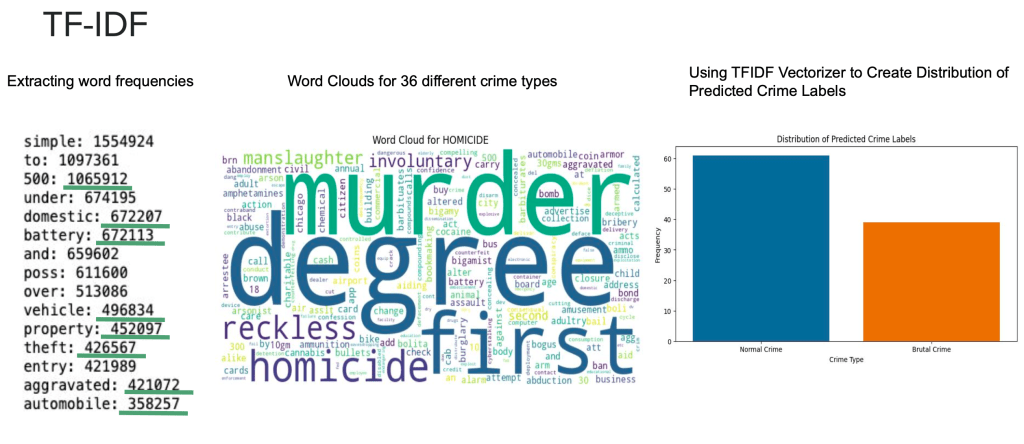
- TF-IDF + Word Clouds → Extracted key terms from crime descriptions and visualized trends across crime types.
- Association Rule Mining (Apriori) → Discovered frequent combinations (e.g., narcotics often precede assaults, property crimes often follow drug-related offenses).
- Visualization: Built dendrograms, hotspot maps, and crime-type distributions to make findings accessible.
Result:
- Identified 200+ crime hotspots across Chicago using clustering.
- Uncovered escalation patterns (e.g., drug-related crimes often precede assault and property damage).
- Found time-of-day crime trends, enabling potential predictive policing strategies.
- Achieved 99% classification accuracy for “Homicide” detection (with caution for overfitting).
- Delivered insights that could improve resource allocation, predictive policing, and public safety strategies.

 Shubham Mishra